A Little Less Blue Skies, A Little More Red Sunsets
Solo exhibition in Draakoni Gallery, Tallinn, Estonia, 2024
The exhibition stems from a concept in geoengineering, stating that in theory it is possible to imitate the activity of volcanoes and thus reduce climate warming. One of the most scientifically studied processes describes the spraying of large amounts of aerosols into the stratosphere, where they would scatter the sun’s radiation and thereby reduce the amount of energy reaching the earth’s surface. It would be a deliberate intervention in the global climate system, it would have to be done for about a few hundred years, and its fully realised form could not be interrupted without catastrophic consequences.
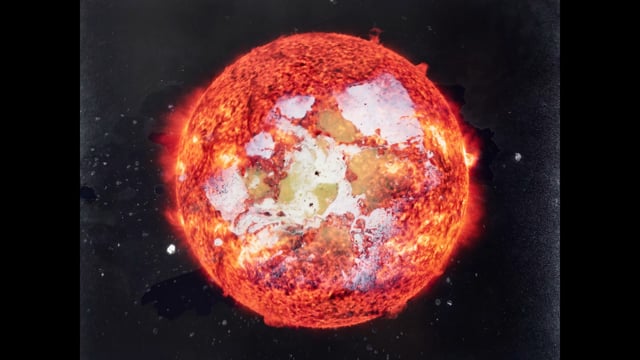
In the works of this exhibition, I have attempted to think about the scope of such process and the intricacies of biological and geological relationships. Photographic prints of close-ups of the sun* become a testing ground for the study of changes made by microscopic life on its surface. Metabolic transformations take place through microorganisms in human saliva brought into contact with an energy source and the surface of the image. Life on the images changes the visible throughout the exhibition and continues to alter it afterwards. I have taken a closer look at the same processes with an electron microscope (SEM), which underlines the morphological complexity of what is happening even more.
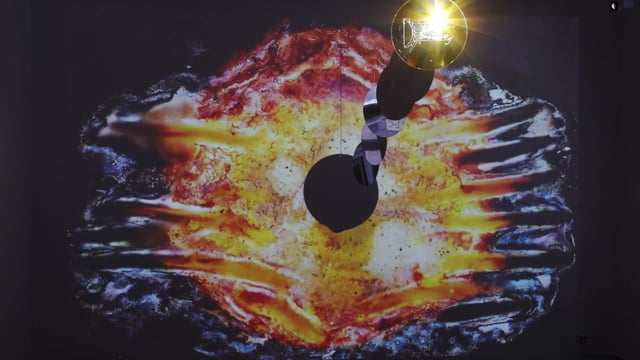
The more abstract part of the exhibition is combined with a video work, which includes material from Effelsberg radio telescope combined with my conversations with several geoengineering experts. The design of one of the world’s largest fully steerable radio telescope is massive yet mechanically relatively simple. It is used to research distant territories far away from Earth, the formation of stars and the disappearance of matter into black holes. Also to detect radio waves from neighboring galaxies. I have chosen this as a research object in order to think about what can be perceived and understood through visibility? How visual simplicity fails to convey the complexity of such sets of relationships? Or how to think of inconceivable scales – some too grand and some too small?